Thursday, December 15, 2011

Lesson 9: ¿Cómo está el tiempo?

The week of  December 4th we did: "How is the weather?" and we went over 7 possible responses, and as with seasons and days and months we go over them during calendar time! So we are reinforcing them continually, so hopefully you guys at home can too! Take a look at the vocab and I attached a video to get 
some of the pronunciation! ¡Disfruten!

¿Cómo está el tiempo?


Hace frío.           
It’s cold. 
             
Hace calor.            
It’s hot.

Hace viento.           
It’s windy.

Hace sol.                    
It’s sunny.

Está nublado.             
It’s cloudy.

Está lloviendo.          
It’s raining.

Está nevando.       
It’s snowing. 


On Fridays of this lesson and the seasons lesson, homeroom teachers played the Whistlefritz dvd on the seasons, apprently it was a big hit. The music is extremely fun and the lessons go right in line with what we are talking about, if you are interested in some good reinforcement materials for home I'd check it out!
 

Friday, December 9, 2011

Lesson 8: Las estaciónes

Alright so clearly going in line with our calendar activities we have added on: The Seasons!!! 

El invierno- Winter
La primavera- Spring
El verano- Summer
El otoño- Fall

The question is: 

¿Cuál es la estación?

Es ____________________. And right now Es otoño. In a couple weeks though it will definitely be invierno... uh ohhh! 

So work on seasons please! We're at a perfect time ending one and coming into another! The next post couples with this lesson as well... hopefully you can see that there is a trend going on with my lessons... that they build on each other!!! 


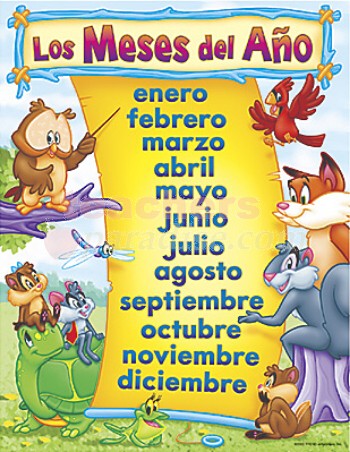
Lesson 7: ¿Cuál es el mes?

Another aspect of our calendar time is telling the date and month. 

We ask the question:
¿Cuál es el mes?
and we respond with:
Es_________________.

And the possible answers are the months:

enero 
febrero
marzo
abril
mayo 
junio 
julio
agosto
septiembre
octubre
noviembre
diciembre

Obviously right now we are in diciembre.. ps months are never capitalized.

So vocab for this unit is asking what month it is and the months of the year. Ask them to maybe sing you the months of the year song- to the same tune of the song in English except in Spanish!!! Have fun let me know if anyone is singing them at home!! 


Lesson 6: ¿Qué día es hoy?

So, for awhile now we've been incorporating calendar activities into the beginning of every lesson. We start with:

¿Qué día es hoy?
and we respond with:

Hoy es _________________. 

And it will either be:

lunes- monday
martes- tuesday
miercoles- wednesday
jueves- thursday
viernes- friday
sábado- saturday
domingo- sunday

¿Qué día será mañana?
Mañana será____________. 

¿Qué día fue ayer?
Ayer fue _____________.

So the vocab they should know are the days of the week, and the questions and proper responses in full sentences. Most kids don't have it down exactly, but if Parents wouldn't mind asking your kids the days of the week or quizzing them on what day is today (que dia es hoy...manana...ayer) or asking them to sing the days of the week train song... and hopefully they will!!


Recapping our show!

Here are a few photographs from the Moona Luna concert, the field trip included the Goldfish, Dragonflies, Grasshoppers and VLA's kindergarteners, first and second graders. 


Shrea and Asha Dancing!!!


Bella and friends.

The group dancing with Ms. Pesola.


They had a ton of different instruments and the music was perfect to dance to! 

Zaria, Ginger, Santori and Arteen!


Overall it was a huge success and I am looking for other opportunities like it! I'll keep you updated when I find them!!! 

Monday, October 31, 2011

Piñata Party!!!!!

I am so excited to announce that we are going on a field trip!!!!!! Monday November 7th buses leave @ 930!!! At Old Town School of Folk Music!!! It is a Moona Luna concert!!! It is 9$ per student for bus and concert... sorry for such short notice... we just can't miss the opportunity!!! Here is a bit about them!!! 


Moona Luna is the passionate second project of New York-based songwriter Sandra Velasquez and her critically acclaimed Latin band Pistolera. For the last five years, Pistolera has toured extensively, delighting fans of all ages around the globe. During the making of Pistolera’s second album, Velasquez gave birth to her first child. But the experience didn’t slow her down.

In fact, with her daughter as inspiration, Velasquez wrote an album’s worth of songs geared for families. After writing exclusively in Spanish for Pistolera, she decided to make Moona Luna’s songs bilingual so that her simple messages of joy, discovery and perseverance would reach more young ears. The band includes Maria Elena on accordion, Inca B. Satz on bass and Sebastian Guerrero on drums.  Dan Zanes joins the Piñata Partyon “Brinca, Jump.”
Velasquez says that Piñata Party is her attempt to re-create the vibe she remembers and treasures from the backyard parties her parents would throw while she was growing up in San Diego, California. Moona Luna certainly caught the vibe: Piñata Party is like a rich and flavorful platter of bold and spicy carne asada. It is an invitation to sample the tastes and flavors of the world from a child’s sensibility—of experiencing the familiar in a way that is suddenly unfamiliar and new.

“Adults can be so jaded,” Velasquez says, “but kids don’t hide the way they feel. They’re the truth. When something brings them joy, they dance. We want everyone to experience the joy in Moona Luna’s music. We want everyone to dance.”
And dance you will. Piñata Party is bursting at the seams with sweet, delicious and satisfying rhythms that will find you heeding the invitation of the opening track – “Quieres Bailar?” – and heading for the dance floor. Nearly every track is a suggestion for young and old alike to partake in the piñata of delights that beckons us at every point of our lives. “Todas Las Comidas (All the Foods)” (now available as a YouTube video) reminds us that food is without a doubt the most delicious way to experience the various cultures of the world; “Brinca, Jump!” perfectly captures the delight we feel in simply putting our bodies in motion; while “Hay Que Trabajar (We All Have To Work)” explains to young children what mom and dad are doing all day even though they would rather be staying home with them.

Sunday, October 30, 2011

Vamos a leer :)

I made up a silly song that I use sometimes... I should try to do it more often... for when I am going to read a book... so that they can hear the verb "leer" to read... and the construction of "Ir + a" = Going to do something... "Vamos a leer" We are going to read... it goes... 

Vamos a leer 
Vamos a leer
Vamos Vamos Vamos todos 
Vamos a leer! x2

What it means:
We're going to read 
Come on everyone 
We're going to read!

Side note... I know it took me ages to find little things like this that work... and I feel like I should do a much better job of sharing.. because it is hard figuring it all out! 

This week in libros...

Here's a look at the books we will be reading this week! Tomorrow we'll read a cute Halloween book! It highlights clothing vocab! So few I can bring my wall into it! Here is some vocab to practice!
la ropa - clothing
la calabaza - pumpkin
las botas - boots
la camisa - shirt
la camiseta - t-shirt
los guantes - gloves
el sombrero - hat/ largerish hat...(more fancy say)
la gorra - cap
la sudadera - sweatshirt
los calzoncillos - undies
los calcetines - socks
tener miedo - to be afriad 
(No tengo miedo---I'm not scared/ Tengo miedo---I'm scared)

I would say with clothing vocab you could ask if they have a sock or if they have a shirt... so let's see... "Tienes una camisa? Si, tengo una camisa! or you could use where is your shirt? "Donde esta la camiseta?... aqui esta la camiseta! Or hold two different pieces of "ropa" up and ask "Es la sudadera o es la sudadera? and have them point to which one is correcto! 

Also, we are going to take a cultural trip into Mexico as we talk about one of it's holiday's Day of the Dead!!! 

I'll list some more day of the dead vocab later this week! 

Great Book!!!

We read this book last week and will probably read it again this week... has been such a hit.. it's a traditional Latin American poem.. that can be sung, put to music etcetera... has the most beautiful illustrations and captures the kids' attention perfectly! Key vocab includes: numbers uno-diez, clock/reloj, esqueleto/skeleton, tumba, lluvia, rey... easy vocab and an easy read I'd recommend purchasing it and reading it at home!! 

Chumba la cachumba

Chumba la Cachumba
Autor: Carlos Cotte
Editorial: Ekaré
Colección: Clave de sol
Género: Poesía tradicional
Edad: Desde los 3 años
Temática: canciones, miedos, poesía tradicional
Una canción tradicional de América ilustrada de forma muy lúdica. Se puede leer cantando, con música, repitiendo sus versos. Particularmente sugerida para niños de primera infancia.


"Cuando el reloj toca las seis
 los esqueletos nombran al rey.
Chumba la cachumba la cachumbaba."

Feliz Noche de Brujas!

I loved seeing everybody dressed up last Friday!!! I know Halloween is actually tomorrow, but hopefully everyone had a blast trick or treating over the weekend! I'm going to share some fun Halloween videos.. and later this week I will post about Day of the Dead. Also, here is the cutest León (mejor dicho leoncito) around! 


Ari from the Caterpillar room...roarrrr!


Ahhh!! Trick or Treat/ Truco o Golosina!!

Our kiddos love watching Disney shorts in Spanish... I am sure some of you have heard them talking about the three little pigs video that I used to have them watch... this one is equally as exciting! Enjoy!! 

There are plenty more videos where these came from just go to the original youtube site and click on other links that look interesting along the side!! 

Finishing up octubre...

Hey ITAV Family,

Last week we talked again about emotions... but this time in the third person. We used pumpkins (or at least should have done a "calabaza" (pumpkin) project with lead teachers... where we would talk about how the Calabaza was.


¿Cómo está la calabaza?
La calabaza está ______.


Feliz---happy!
Triste---sad
Enojada---angry
Contenta---content/happy
Asustada---scared
Bien--- good
Cansada--- tired
Emocionada--- excited

So most of your kiddos know how to tell us how they are… now we want them to work on telling us how someone else is… so the same sentence can be used instead of saying “como esta la calabaza?”… we could say “como esta mama/ papa”… or if you have a pet at home (mascota) “como esta el perro?” Or “como está el gato”… same thing “el gato está enojado!”

This lesson also reminded and reinforced gender agreement… LA calabazA esta enojadA not enojadO when working at home make sure to reinforce that they are using their adjectives correctly… when talking about feelings of feminine words their emotions must end in a/o accordingly! If this is confusing ask me about it!

Ms. Jessie

Getting ready for Dia de los Muertos...

Here is a poem by Lope de Vega that works with some vocab we will be talking about next week... not exactly my usual up beat kid friendly song but I was thinking a bit more parent friendly. I think it's beautiful, if you would care for a listen :) 


A una calavera 
by Lope de Vega
Esta cabeza, cuando viva, tuvo 
sobre la arquitectura destos huesos 
carne y cabellos, por quien fueron presos 
los ojos que mirándola detuvo.

Aquí la rosa de la boca estuvo, 
marchita ya con tan helados besos, 
aquí los ojos de esmeralda impresos, 
color que tantas almas entretuvo.

Aquí la estimativa en que tenía 
el principio de todo el movimiento, 
aquí de las potencias la armonía.

¡Oh hermosura mortal, cometa al viento!, 
¿dónde tan alta presunción vivía, 
desprecian los gusanos aposento?

To a Skull

This head, when alive had 
On the architecture of its bones 
Flesh and hair, by which the eyes, 
That stopped to look at it, were made prisoners. 


Here the pink mouth was 
Fading already with such cold kisses, 
Here the emerald eyes were imprinted, 
Color that entertained so many souls. 


Here the judgment that was 
The source of all movement, 
Here the powers of harmony.  


Oh mortal beauty, kite in the wind!, 
Where such lofty presumption lived, 
The worms despise the chamber.


Lyrics thanks to a wonderful blog called Mama Lisa's World

Monday, October 17, 2011

Spanish Worksheets!!!

Dear Potential other teachers who maybe sometimes look at my blog... today I struck just absolute gold as far as Spanish primary age level worksheets! I want to share it before I forget!! Enjoy!! 

Ms. Jessie :)

The Website is http://www.lacasainfantil.com/ it is wonderful... here is the page I'm on! 

Friday, October 14, 2011

Lessons 1-5 Review

Hey ITAV Family,

Please feel free to gauge your child's Spanish progress with this assessment chart! Print it off and see where your kids are lining up! Any questions or concerns or suggestions regarding your child and Spanish please feel free to share! Feliz Friday :) 

Ms. Jessie


Communication Objective
Does not meet expectations
Meets
expectations
Exceeds
expectations
1.         Student tells what his or her name is.

·          Student comprehends the questions “¿Cómo te llamas?”
·          Student answers the question using the phrase, “Me llamo _____.”

2.         Student exchanges greetings and expresses how he or she is feeling.

·          Student comprehends and appropriately uses hola and adios.
·          Student comprehends the question “¿Como estás?”
·          Student answers the question using a word or phrase that expresses how he or she is feeling.

3.         Student identifies colors and provides information about colors around him or her.

·          Student comprehends the question, “¿De qué color es?”
·          Student answers the question and identifies colors in Spanish.

4.         Student counts to ten and provides information about how many there are of a given number of objects.

·          Student identifies the numbers 1-10 in Spanish.
·          Student comprehends the question “¿Cuántos hay?”

5.         Student identifies shapes and provides information about the number of sides of each shape.

·          Student identifies common shapes in Spanish.
·          Student comprehends the question,“¿Cuántos lados tiene el ____?”
·          Student answers the question using the phrase, “Tiene ____ lados.”


Thursday, October 13, 2011

Otoño

So, I'm in charge of doing a Spanish "bulletin board." Yes, it was only supposed to be a bulletin board, but then one day I used the whole wall... and then the next time I used the other wall and I made this cool Palm tree summer scene... now all of a sudden I feel like I have to keep it looking great... so here is me tooting my horn.... my fall scene :) The espantapajaros (scare crow)... hasn't fared so well... the head has popped off quite a few times.. and the fence I usually find in pieces when I get in in the mornings.... ha. But, it sure looks great when it's put together... Someone gave me the idea.. to make it a clothesline.. to highlight some clothing vocab... it's a bit out of order... I'm not quite onto clothing yet... but hopefully parents have been stopping by to practice the words with their kids... (I've seen quite a few families do that! Awesome!! Yay for you guys!!!) Hopefully this is helpful for someone thinking of decorating ideas! In my scenes... I usually always do some sort of tree... and I have left the sun and clouds and birds for quite some time as well... but they transfer over well... made the clouds ripply to make it 3Dish.. and brought in some leaves from out side... to sprinkle the ground with it was fun... and the calabazas (pumpkins) add a nice touch as well. 


Here is Aiden from the Dragonfly room posing with our Espantapajaros and the cometa (kite.)


Spanish for Parents!

Hey Parents,

If you are jealous that your kiddos are learning a second language and you might be falling behind here are some resources to keep you caught up or catch you up on your Spanish! Take a look around if interested! 


Take a look around if you are really interested these are great finds!! Enjoy!!


Lesson 5: Las formas.

This weeks lesson was on shapes! The lesson objective was for students to identify shapes and provide information about the number of sides of each shape. We didn't exactly get to piggy backing on the counting lesson with asking and answering the question "¿Cuántos lados tiene el _______?" and answering with "Tiene __________ lados." This week we just worked on identifying the shapes properly. I will continue to review counting and work on this question for next week as well! So Parents feel free to help me out!! Practice identifying shapes and asking your kids how many sides each shape has using the correct question and response! 

Vocabulario:


¿Cuántos lados tiene el _______? (how many sides does a ___ have?)
Tiene __________ lados. (It has ____ sides.)


Las formas  


rectángulo
triangulo
semicírculo
óvalo 
diamante 
triangulo 
corazón 
cuadrado


At the end of this week students should be able to identify common shapes in Spanish. By next week they should be able to comprehend the question ¿Cuántos lados tiene el _______? and respond properly with Tiene __________ lados.

We also read a book called Las formas en el arte which reminds us that : Las formas estan por todas partes... (Shapes are everywhere) keeping this in mind... work on identifying shapes and counting sides with your children when the opportunity arises which it will often!


Ms. Jessie 

Lesson 3: ¿De qué color es?

Week 3’s lesson was on colors. We introduced and practice the phrase “¿De qué color es?” and practiced responding properly with “Es________.”

In this lesson studnets identify colors and provide information about colors around them. They can comprehend the question “¿De qué color es?” and answer the question and identify colors! Be sure to incorporate color practice at home! Perhaps you could ask your kids the question ¿De qué color es? while you are reading there favorite bedtime story while pointing to different colored pictures on the pages! Have fun with colors! Plenty of opportunities to practice with colors because they are all around us! 

Vocabulario:

¿De qué color es? (What color is it?)

Es________. (It's ____.)
Rojo anaranjado azul amarillo verde negro blanco rosado morado marrón gris

Have FUNNNN! ¡Que lo pasen bien!

Love,

Ms. Jessie

Books I use to teach colors: